Decorating Eggs is an Ancient Custom

Wooden Easter Eggs are a Polish tradition.

Pinsanki is the Polish word for Easter eggs. It comes from the verb pisac which means to write. Beautiful carvings on wood or melted wax drawn on an egg to withstand dye was used to decorate the eggs. I had students from the Ukraine who knew women who used the wax and dye method, and they said it was a tradition in some families but not theirs. I would have loved to have seen these eggs.

I don’t know where I got my two wooden eggs, but I display them every year. I read that wooden eggs have been used at the White House Easter Egg Roll since 1981 when President Reagan and his wife offered eggs that had the signatures of famous people. They became a valued treasure. Egg rolling represents the stone being rolled away from Christ’s tomb.

Decorated eggs have been associated with spring for thousands of years and in burials. Farmers would bury them in the field to ensure fertility of their crops. Eggs also represented rebirth and Ostrich size eggs made from silver and gold have been found in the tombs of ancient Egyptians. Real ostrich eggs that had been decorated were also found in tombs that were painted, and engraved. These are believed to represent the soul would be resurrected.

Early Christians dyed eggs red to represent the blood of Christ being shed on the cross. In Greece, the red eggs are used to play an egg cracking game. The tips of the eggs are tapped together and the person with the unbroken egg then tries to crack the other end of his opponent’s egg. While cracking, one person says, Christ has risen. The other responds, Indeed he has risen. The person with the unbroken egg believes he will be rewarded with good luck.

Many of us will color Easter eggs soon and will fill baskets with chocolate eggs and bunnies. Cadbury made the first chocolate egg in 1875 and they are still being made. I am a fan of Hershey’s little chocolate eggs. They fit nicely inside a plastic egg. One of these years I want to try the wax and dye method. If I do, I’ll let you know.

The Happiest Faces of Spring

Pansies bring joy with their bright colors and cheerful smiles.

I can’t remember an Easter that pansies weren’t outside in pots and Easter lilies weren’t inside filling the house with fragrance. I have happily continued this tradition that my mother started.

As you know, I enjoy research and even though I knew that pansies are edible ( I wouldn’t eat them) I didn’t know that they had been used for medicinal purposes. Chinese medicine used them at one time to prevent cancerous tumors and also as a source of nutrition. The Greeks thought that anger would be reduced by munching on a pansy and the Romans believed they cured headaches and dizziness. Plants have always been used to treat ailments, so it’s not surprising.

I also learned that in Victorian England it was not proper to openly express affection, so pansy bouquets were wrapped in doilies and quietly passed to a sweetheart. Today they are considered a gift of platonic love to be given a parent or a friend. Like most flowers, the color carries a meaning. I love all the colors and this year I have orange pansies for the first time.

If you are looking for something to bring you or someone else a daily dose of happiness, fill a pot with an assortment of pansies and set it on the porch. Every day when you leave the house and return, you will be greeted with smiles!

The Artistic Eye!

Beautiful pieces of art have been created for centuries from a variety of metals.

Once ores were discovered, man began shaping it into useful items like cups, bowls and plates. It didn’t take long for man’s artistic nature to want to make these objects beautiful. Prior to metal, shells, stones, bones and animals skins were used in creating objects of beauty. Even primitive man created jewelry.

I love this bird that was created by drilling three holes into a stone and then attaching the metal parts. The other piece has color and dimension in the metal. I think both show the artist’s creativity and skill.

Long ago people decorated the doors of churches with elegantly created metal hinges and handles. Metal workers were hired to create beautiful chalices, crosses and candlesticks for the church. Wealthy Romans paid for metal art pieces to hang on the walls of their homes in addition to creating decorative cups and candlesticks for their personal use. The wealthy Egyptians adorned themselves with jewelry made from gold and silver. These pieces included precious stones such as lapis and amethyst.

I find it exciting to see metals used with wood, cloth, and stone. It expands the uses and the realm of creativity. Clock makers were experts in combining metal with wood not only in making the clock work, but in making the clock on object of beauty.

Metal art has become popular and is seen in many stores and art festivals. A little research showed that Pablo Picasso was interested in using metal as an art form and experimented with it. Tools for working with metal have made creating unusual pieces easier and has allowed the creative mind to expand. So, once art festivals return, I hope you’ll spend some time admiring the metal pieces of art.

Dr. Seuss, Oh No!

Dr. Seuss was a racist?

I love Dr. Seuss books and used them in teaching. Every year I taught a unit on discrimination, and I read The Sneetches to my students. It’s a story about the Star Belly Sneetches and the Plain Belly Sneetches. Each thought they were the best ones on the beaches. In the end, they learned a Sneetch is a Sneetch and stars on bellies don’t matter.

Ted Geisel was born in 1904 and died in 1991. He went to Dartmouth College and is said to have written racist books. A man who wrote the Sneetches could not have been a racist. Knowing the time period he lived in, racism was common and if he did write racists books while in college, he changed. Education and life experiences can correct one’s faulty thinking of his youth.

He also wrote The Lorax which is an environmental book. I loaned my copy to the science teacher who read it to her students. The Sneetches and The Lorax both added to our students’ education in a fun way that they remembered.

I was privileged to sit on my local school board years ago, and I remember parents wanting certain books banned. As a teacher, I had a parent that wanted not only his child not to read a book, but to prevent all the students from reading it. I am against banning books. People should be free to decide for themselves if a book is appropriate for themselves or their family. By the way, my student was allowed to read something else. No problem, that was standard policy.

Dr. Martin Luther King wrote in his I Have A Dream speech that he dreamed of people being judged by the content of their character. I think The Sneetches clearly show Ted Geisel’s character.

Lies are Revealed!

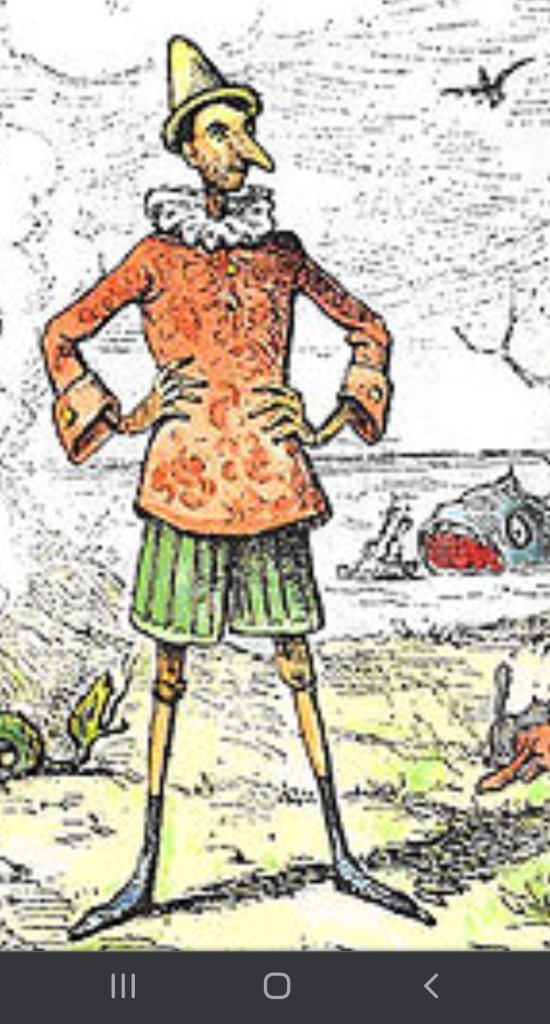
Enrico Mazzanti drew this Pinocchio.

In 1883, Carlo Collodi wrote The Adventures of Pinocchio. Walt Disney made him famous in America and many of us grew up being reminded that if we told a lie our noses might grow like Pinocchio’s did. I learned about his origin when we were in Italy because there were Pinocchios everywhere when we were in Tuscany. Collodi was from Florence, Tuscany.

Pinocchio got me thinking about how amazing it would be if our noses grew when we told a lie. I decided that would be physically impossible, but what if we got a case of hiccups, or our eyes couldn’t stop blinking. I can picture politicians’ speeches being interrupted by endless hiccups.

Some people are said to have a tell when they lie. Children frequently look down or away. I’ve heard of people who have a facial tic that is activated when they lie. I’ve never seen this, but can you imagine if everyone in Congress had that infliction?

During this season of Lent, many strive to overcome bad habits. They stop swearing, smoking, drinking, etc. Christians throughout the world use this time to do these things, but to also grow closer to God. They read the Bible in daily devotionals, and they pray more. I’ve never heard anyone say I’m going to stop lying, but it would be a good thing to do.

The stories of my childhood almost always had a lesson. Carlo Collodi taught an important lesson by creating Pinocchio.

Love, Love, Love!

Valentine’s Day is celebrated throughout the world with a variety of traditions.

As a child I loved Valentine’s Day because of the cards. Today the kids get candy along with the cards, but we just exchanged cards. I can remember looking over each card carefully and deciding who to give each one to. When we exchanged them at school, it was quiet while we read the cards’ special messages. It’s a nice memory. Of course cupcakes and punch are also a part of the nice memory.

In Japan it is customary for women to give chocolate to the men in their lives. The quality of the chocolate determines the quality of the relationship. A co-worker would be given chocolate of lesser quality than chocolate given to a sweetheart.

I grew up hearing the expression, She or he wears his heart on his sleeve. In South Africa, girls literally pin the names of their sweethearts on their sleeve. I read that some men do the same.

I think the people of Finland and Estonia have a wonderful February 14 tradition. They call it Friends Day and remember friends with cards and gifts. We teach our children to remember friends with kindness on Valentine’s Day by the card exchange at school, and adults do remember their friends with a card or small gift on this day.

Today is a special day to tell others you love them. There is a lot of love in the world and we need to remember that. Let us focus on loving each other and being thankful for all the things we love like animals, food, books, flowers, etc. The list is long! Happy Valentine’s Day to all my friends!

Candlemas is Feb.2

Groundhog Day is February 2, but why?

Groundhog Day falls midway between the winter and spring solstice. People eager for spring to arrive wanted to know just how long they had to wait for warm temperatures. Like many of our American traditions, it was the German settlers who brought the idea of watching an animal on February 2 to determine if the animal saw its shadow. A sunny day was certain to mean there would be six more weeks of winter.

February 2 was known to ancient people as Candlemas. This was the day that the clergy blessed candles and gave them to the people to see them through the winter. The custom was to set the candles in the windows of one’s homes on this day.

For some reason Germans took to watching badgers on this day in an attempt to make a weather prediction. After all, animals should know, right? When the German settlers came to America, they decided on the native groundhog to watch.

Groundhog Day was first officially celebrated on February 2, 1887 in Punxsutawney, Pennsylvania. Germans settled in this area during the 18th century. I can’t help but wonder how long it takes a child to learn how to spell the name of the town they live in. Thank goodness for spell check!

Canada’s famous groundhog is named Wiarton Willie and lives in Bruce County, Ontario. He doesn’t look like the groundhogs we see eating along the side of the road, he is all white. He does predict like the various groundhogs around the U.S.

It’s amazing how blessing candles led to watching a groundhog on February 2. I never knew about Candlemas until I did a little research. I like the idea of candle blessing. That would make a dark winter’s night brighter.

Where Do You Find Joy?

January is a long, dark month and finding joy keeps the heaviness at bay.

I always wish for snow in January because it brings me joy. I’m not talking about a lot of snow, just a couple inches. When snow is on the ground, the early darkness isn’t so bad and when the moon is shining, the night has a magical quality.

This little angel of joy caught my eye with the rainbows on the wall. I have crystals hanging in the window, and in the late afternoon rainbows cover the walls. It’s impossible to enter the room and not be filled with joy. Of course if I have rainbows, that means the sun is shining. Any day the sun shines is a joyful day.

One of my granddaughters called me yesterday to tell me she had used her birthday money to buy a new doll. Talk about joy! Her joy was contagious and as I listened, I smiled and shared her happiness. Later she sent me a picture of herself with her doll. More joy!

I was able to go to another granddaughter’s basketball game this week and the happiness I felt for being able to go can only be described as joyful. I’m so aware that time goes by so quickly that I want to be a part of her activities as long as I can. Graduation comes quickly. It was a joyful evening.

I wish all of you many moments of joy this month. I know if I bake chocolate chip cookies today for my husband, I will bring him joy. My mother used to say, It’s the little things in life that makes us the happiest. I think she was right.

What a Night!

Mary was chosen.

Mary was a young girl by today’s standards. This was her first child and to have been far from home when she went into labor would have been frightening.

I always thought how sad it was that there was no room in the inn until I had a baby. Now I see the wisdom in being sent to a stable. The inns were crowded which meant they were noisy and probably dirty. Who’d want to have a baby under those conditions? Not me.

Clean straw or hay and fresh air would have been better. Maybe Mary could see the star and concentrate on its beauty as she went through labor. I like to think the innkeeper’s wife was there with water and clean cloths to deliver the baby. I think God would have provided support for her.

I wonder what she thought when shepherds arrived telling her about angels announcing her son’s birth. Had she been surprised or had she just smiled realizing God was spreading the word that his son was born. The long awaited child that Isiah had prophesized was here at last. God was a proud father!

This was a joyous night that Christians all over the world remember. I can’t imagine the responsibility of raising God’s son. Mary clearly loved and trusted God or she would not have been chosen. She is a blessing to all of us who celebrate Jesus’s birth. Thank you, God!

A Snowy Path to…?

Where does this path lead?

A familiar story idea is about following paths. I always liked how Gretel tried to mark the path to her and Hansel’s home with bread crumbs. As they continued their way through the woods they found a house made of gingerbread and covered with candy. As they discovered, looks can be deceiving.

Teachers and parents also like to use paths in discussing which path children should follow when it comes to career, behavior or group of friends to follow. In short, the subject of paths has a lot of material for people to write and talk about.

In my mind, the path is leading to a barn that holds an old sleigh that has been lovingly painted and repaired. A sweet old man, who looks like Santa, lets me pet his horse that pulls the sleigh. I offer to help with chores if he will show me how to drive the sleigh. Mucking out the barn is worth the lesson. My fantasy ends with driving the beautiful red sleigh through the woods.

Christmastime is a magical season of lights and dreams. For me, the snow adds to the feeling that anything is possible. I would love to hear where your paths would lead. Happy imagining!